
As we moved through the 2024-2025 flu season, conversations about vaccination were more relevant than ever, especially amid heightened concerns over influenza and RSV surges that were straining healthcare systems. That season stood out as one of the most challenging in recent memory, rekindling public discussions about the value of immunization.
Vaccination is no longer just a routine healthcare decision—it’s about personal experiences, cultural influences, and the way different individuals see the world. Some view vaccines as essential safeguards, while others remain uncertain about medical advancements.
This report takes a close look at the perspectives of individuals across Germany, Spain, France, the United Kingdom, Italy, and the United States. By understanding their motivations, concerns, and cultural differences, you'll gain valuable insights into what shapes public trust in vaccination today.
Vaccination Perception Across Key Groups
The question of who should be vaccinated reveals important patterns shaped by cultural priorities and public health narratives.
At-Risk Individuals
Support for vaccinating vulnerable groups remains high across all countries, with the UK and US (85%) emphasizing protection through strong public health messaging. In Germany and Spain, strong support (83% and 84%, respectively) reflects cultural values that prioritize community well-being and national initiatives aimed at protecting the elderly.
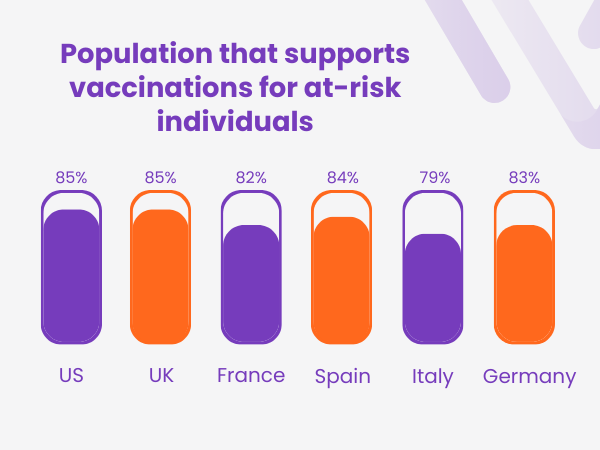
France shows 82% support, acknowledging the need despite rural skepticism linked to limited healthcare access, informal sources of information and traditional beliefs. Italy presents slightly lower support at 79%, driven by healthcare disparities and a history of skepticism in rural areas.
Infants
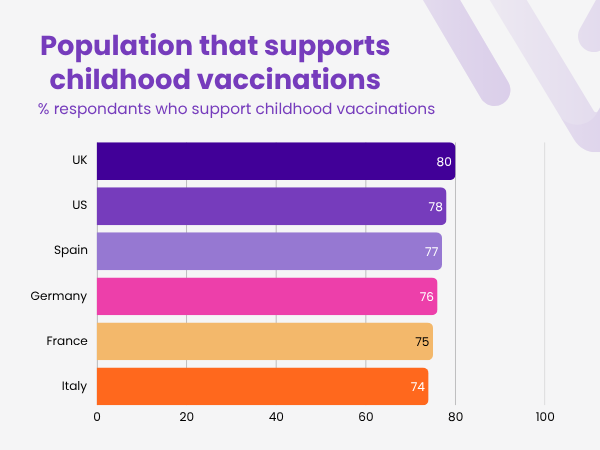
Childhood vaccinations receive strong support, with the UK (80%) leading due to successful past campaigns that eradicated diseases like measles. The US (78%) sees higher approval in urban areas with robust pediatric care. Spain (77%) and France (75%) maintain high levels of approval, supported by comprehensive childhood vaccination programs. Germany reports 76% support, aligned with trust in structured public health policies. Italy shows 74% approval, though adult vaccination hesitancy occasionally impacts discussions around broader immunization efforts.
Adults Over 18
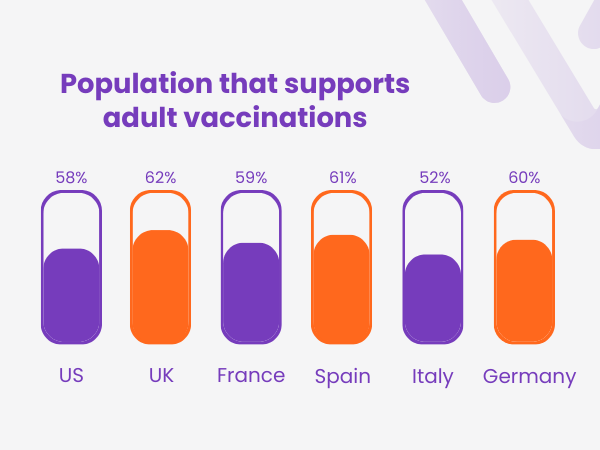
Support for adult vaccinations is more fragmented. The UK (62%) and US (58%) exhibit steadier support, bolstered by workplace vaccination programs and messages highlighting the benefits of long-term health protection. Germany (60%) reports balanced support, though booster fatigue is noted. Spain (61%) demonstrates resilience, thanks to cohesive public health communication. In France (59%), perceptions are more mixed, reflecting hesitancy regarding booster shots. Italy reports the lowest approval (52%), driven by skepticism over repeated vaccinations for young and healthy adults.
Pregnant Women
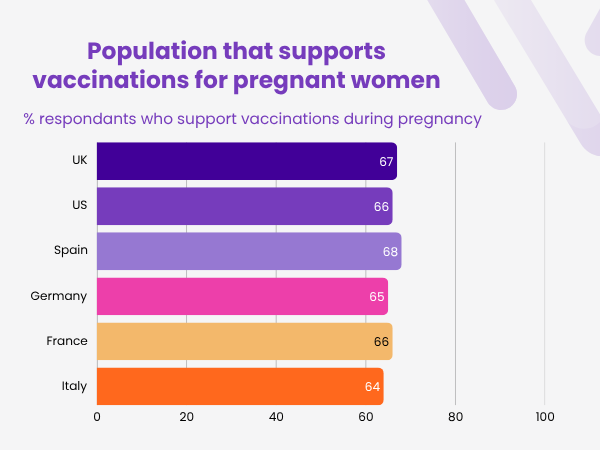
Opinions are significantly varied when it comes to vaccinating pregnant women. Spain leads with 68% support, thanks to targeted campaigns that stress maternal and infant health. In the US and France, around 66% of respondents support vaccination during pregnancy. In the US, cultural emphasis on bodily autonomy in rural areas contributes to hesitancy, while in France, media debates over long-term safety influence public sentiment. In the UK (67%), trust in health guidelines bolsters support despite some individual concerns. In contrast, Germany (65%) and Italy (64%) display lower support, reflecting broader concerns about transparency and long-term effects.
Institutional trust significantly impacts these figures. In countries like the UK and Spain, strong public health networks foster confidence, while Italy contends with fragmented narratives shaped by historical controversies, such as the 2017 debate over compulsory childhood vaccinations and political opposition to mandatory immunizations. Where trust is high, vaccination rates follow.
What Motivates People to Get Vaccinated?
Vaccination decisions reflect deep-rooted cultural values and regional priorities, shaping how communities perceive health responsibilities. The data reveals not only a strong sense of individual responsibility but also how cultural narratives frame decisions. Across all countries, the desire to protect loved ones, maintain personal health, and contribute to community safety emerged as key themes—each shaped by distinct societal factors.
- Protecting Loved Ones: Family protection is a dominant motivation across Europe and the US. Spain leads with 88% of respondents citing family-centric reasons, followed closely by the UK (87%) and the US (85%), highlighting strong intergenerational bonds and caregiving traditions. Germany reports 84% support, while France (83%) and Italy (82%) demonstrate high family-related motivations, though rural regions in these countries sometimes express ambivalence.
- Personal Protection: Self-protection emerges as a key driver, particularly in Germany (80%) and the US (81%), where recent health crises have heightened awareness of individual vulnerability. The UK (78%), France (77%), Spain (79%), and Italy (76%) reflect similar concerns, though perceptions of personal risk vary by demographic and region.
- Community Responsibility: The emphasis on civic duty differs by country. Spain (75%) and Germany (70%) strongly emphasize community health, underscoring cultural commitments to collective well-being. The UK (72%) and the US (69%) also show notable support for community responsibility, though rural areas in the US often prioritize individual choice. In contrast, France (68%) and Italy (65%) reflect more individualistic perspectives that temper support for broader public health efforts.
What Drives Vaccine Hesitancy Around the World?
Despite robust vaccination campaigns, hesitancy remains a significant factor influenced by concerns about safety and effectiveness.
Long-Term Side Effects
Uncertainty about long-term safety fuels skepticism. In the US, 35% of respondents cited long-term risks, often linked to varied state-level narratives that foster mistrust. In France, 32% expressed apprehension, influenced by prominent media coverage of adverse effects that have fueled public anxiety. Germany reports 30%, reflecting a balanced perspective shaped by measured public discussions. The UK registers 29%, where institutional trust in the NHS mitigates fears, though some skepticism remains. Spain shows 28%, demonstrating relatively lower concern due to effective public outreach that emphasizes safety. Italy, at 29%, continues to grapple with historical controversies that have shaped vaccine hesitancy.
Short-Term Side Effects
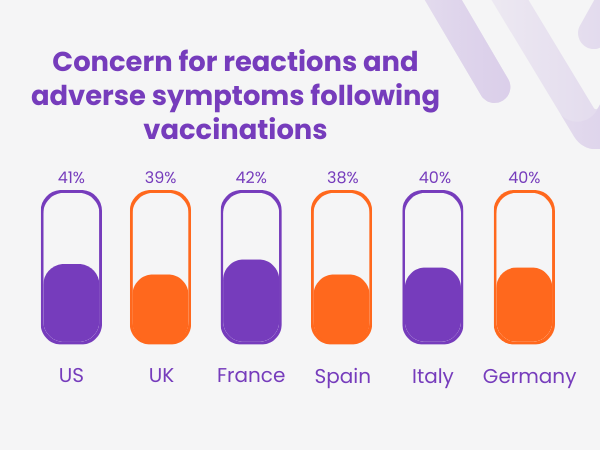
Reactions such as flu-like symptoms remain another prevalent issue. France reports the highest concern at 42%, underscoring public sensitivity to immediate side effects. In the US, 41% of respondents voiced apprehension, often influenced by anecdotal accounts shared through local media. Germany (40%) and Italy (40%) report similar levels, reflecting ongoing concerns about discomfort post-vaccination. The UK follows at 39%, where public reassurance campaigns have helped contain fears. Spain reports the lowest concern at 38%, supported by comprehensive post-vaccination care initiatives that reinforce public confidence.
Confidence in Effectiveness
Skepticism about vaccine efficacy persists across regions. In Italy and France, 21% of respondents expressed doubts about the necessity of repeated doses, reflecting broader concerns about booster shots. The US reports 20%, with responses influenced by regional disparities in public health messaging. The UK and Spain both report 19%, reflecting steadier levels of trust in immunization programs. In Germany, 20% of respondents expressed concerns, although a strong public health framework has maintained relative confidence.
Public Trust and Media Narratives: Who Controls the Story?
In France, where 32% of respondents expressed concern about long-term side effects, high-profile media reports on adverse effects have heightened public anxiety. Conversely, Germany (30%) and Spain (28%) have more balanced reporting, which helps sustain trust in public health initiatives.
In the US, where 35% cited concerns about long-term impacts, regional media discrepancies lead to varying levels of trust, with urban areas often displaying higher confidence due to consistent public health messaging, while rural regions may encounter conflicting narratives. The UK's NHS-led communication strategy supports relatively low concern levels (29%) through consistent, transparent outreach.
Italy presents a more complex picture: 29% of respondents expressed concern, reflecting how mixed narratives—shaped by past vaccine controversies—continue to influence public perceptions.
Vaccination Sentiments: Hope, Fear, or Uncertainty?
Sentiments surrounding vaccination reflect a rich tapestry of trust, caution, and lived experiences. Analysis of open-ended responses shows that individuals across regions express a mix of positive and apprehensive feelings.
Positive associations include terms like “Protection,” “Confidence,” and “Safety,” which underscore the belief that vaccination is a cornerstone of public health. In contrast, terms such as “Skeptical,” “Side Effects,” and “Anxious” highlight lingering concerns about potential adverse effects and mistrust fueled by inconsistent communication.
Notably, Spain and the UK emphasized protection for loved ones, which aligns with the high percentage of respondents citing family safety as a primary motivator. Conversely, France and the US saw more mentions of skepticism and side effects, reflecting how media narratives and historical controversies shape public perception.
What Drives Differences in Vaccination Perceptions?
Public perceptions of vaccination vary widely due to cultural, political, and economic differences. In Southern Europe, vaccination is often viewed as a family obligation, though rural areas tend to be more skeptical due to limited healthcare access and traditional beliefs. In the US, rural communities prioritize independence and often see vaccination as an imposition rather than a preventative necessity.
Media narratives further highlight these differences. In France, intense focus on potential side effects fuels public hesitation, while neutral media coverage in Germany and Spain contributes to lower levels of concern. In the US, state-specific media messaging amplifies divisions, leading to fragmented public opinions.
Trust in healthcare systems also plays a defining role. The UK's NHS fosters strong public confidence, whereas historical healthcare controversies in Italy and France have weakened trust. In the US, trust varies sharply by region, reflecting broader social and political divides.
Understanding these differences is essential to tailoring public health campaigns to resonate with diverse populations.
The Role of Pharmaceutical Companies: Trust Starts with Transparency
Pharmaceutical companies have a responsibility - and an opportunity- to lead with transparency and empathy. People don’t just want to be told a vaccine works; they want to understand why and how it protects them. The key to building trust isn’t just data - it’s storytelling.
When people hear real stories from healthcare workers, parents, or individuals who have benefited from vaccines, the science becomes personal. It’s no longer about a distant recommendation - it’s about someone like them making a decision that changed or saved a life.
Marketing also has a massive role to play. Messaging should meet people where they are - both physically and culturally. In some regions, focusing on family protection resonates. In others, emphasizing personal choice and autonomy is key. Strategies that reflect these values will always be more effective than one-size-fits-all campaigns.
Leveraging Market Research to Drive Impact
Market research serves as a critical tool for both healthcare organizations and public institutions to navigate these challenges. By segmenting audiences, it allows stakeholders to identify the specific needs, concerns, and motivators of different groups. For example, surveys and focus groups can uncover why certain populations remain hesitant, while in-depth interviews and ethnographic research provide deeper insights into the cultural and personal factors driving these hesitations.
Market research also enables ongoing testing and refinement of messages. Tools like A/B testing help evaluate which campaigns resonate most, while feedback loops ensure continuous improvement. By staying attuned to emerging trends through methods such as participatory action research or observational studies, healthcare organizations and public institutions can adapt their strategies to reflect evolving public sentiment.
Conclusion
The data highlights significant trends and cultural nuances in vaccination perceptions across Germany, Spain, France, the UK, Italy, and the US. Vaccination for at-risk individuals remains a priority, reflecting a universal understanding of the need to protect vulnerable populations. However, perceptions of vaccinations for pregnant women and adults vary, influenced by concerns about safety, necessity, and historical context.
While Europe and the US share common motivators, such as family protection, cultural values create distinctions. Southern European countries emphasize family obligations, while rural US regions prioritize individual autonomy. Media narratives and trust in healthcare systems further shape public sentiment, with the UK maintaining higher institutional trust compared to the fragmented landscape in the US.
Vaccination isn’t just a medical decision - it’s shaped by trust, culture, and personal experiences. Understanding these dynamics is critical for those on the front lines - whether it’s pharmaceutical companies, healthcare organizations, or those shaping public awareness. Recognizing these influences can help you develop more meaningful strategies to improve public health outcomes.
Ready to turn these insights into action? We’re here to help you simplify your healthcare research. Connect with us now>